Tuesday, 21 June 2016

Writing Setting and Character

Hey guys!

Last Saturday evening, I attended a writers' group that I've been attending for a few months now, run by Hannah Retallick. While we were there, we talked about setting and character, specifically how to combine the two for good descriptions. 
I thought it'd be a good idea to post what we talked about over here on my blog, along with the writing exercises that I did. So, here goes. This is being written directly from my notes, by the way, so if it feels awkward or strange in bits, it's probably me trying to convert my notes into an article, which is harder than it looks, let me tell you.

The first thing we did was go through a brief overview of what it meant to combine Setting and Character. This bit was all about using details in order to bring the setting to life. Then we did our first exercise. For this exercise, we had to write two or three sentences describing our respective houses, using unique details rather than bland ones in order to bring it to life. The following is what I wrote. 

Exercise 1
My House

The front door opens into a long cream-walled hall, one wall lined with books, a wardrobe and a cabinet. A skylight peaks down the carpeted stairs. Outside a little wooden shed sits at the bottom of the gently sloping garden, with a big tree that's nearly the size of the house looming over it.

Obviously, not my best work, but still you get the basic idea. 

We then went into more detail about the topic. We were told to use all the senses, sight, touch, smell, taste and sound. Think, how would the character react?
There are several different ways in which character influences description. 
First is general interest. When an architect walks into a beautifully designed church, they would notice the architecture, would ask about the architecture. Show the reader what makes the person tick. Secondly, show what's important to them. Character is important. Just because everyone walks into the same place, does not mean they will see the same thing.
Thirdly, think about their emotional connection to the place. Either they have one, in which case positive or negative it'll influence how they look at it, or they don't, which is important in itself. For example, say a character walks into a school. If they had a good experience when they were in school, they'd have a different reaction to someone who had a bad experience. If they didn't have an experience at all, because they didn't go, then they'd have a different reaction again. 
Finally, the character's state of mind in the present. Right now, at the point you're writing about, how are they feeling? If they don't want to be there, then they'll have a different reaction to a place than someone who does want to be there. What if they're really angry or upset about something? When they walk into somewhere, what they pay attention to will be influenced by their feelings. 

The final exercise was spaced over about fifteen minutes. We had to write a short story/description combining setting and character. We could describe a fictional place or a real one. I, naturally, chose a fictional place. Here it is. 

Exercise 2
I stare up at the grey-stone walls surrounding Mirror-Creek Manor with an icy feeling in my gut. I glance to the side, where Simon stands, grinning at me.
“I'm really not sure about this, Si,” I say, trying my best not to sound as scared as I am.
“Why?” Simon laughs. “You're not scared are you? You don't really believe it's haunted?”
I bite my tongue and straighten my back. “Of course not,” I snap and that's the final push I need. I stalk forward and dig my fingers into the stone-wall. It's cold, sending shivers up my arms. But I can't turn back now. I haul myself up the wall, bit by painful bit. By the time I reach the top of the wall, my hands are torn and my shoulders are on fire.
I take a deep breath, staring into the overgrown garden. The black and grey house looms over the garden, the shadow covering much of it, like dark fingers trying to suck in all light and life.
“Well,” I mutter to myself. “I've come this far.”
I shove myself off the top of the wall, the wind howling in my ears as I fall and land on my hands and knees in a thorn bush. I jump to my feet and clamber out. I look at my arms. Honestly, I look like a pincushion I've got so many thorns stuck in them.
I heave a sigh and look longingly back at the wall.
“I've come this far,” I mutter to myself and start forward. My trainers crunch against the frost-bitten over-grown grass, as I force my way through the undergrowth. I catch brief glimpses of the snow-white sky between trees every so often, but they never last long.
Finally, I reach the end of the garden and stumble onto a patio.
The patio is made of rotting mahogany that might have looked very beautiful in its day, but now looks old and decrepit. An eerie creaking rips its way through my bones, as I spin around, only to see a broken rocking chair, moving back and forth in the wind.
I clench my teeth.
“Nothing to be afraid of,” I mutter to myself. “You're being ridiculous.”
The shadow of the house is even worse here, looming over me as though it wants to eat me.
I walk forward, stepping as lightly as I can. The patio looks like it's about to fall to pieces. I reach the door and easily push it open, staring deep into the black hallway. I can't see anything. Anything at all.
I'm pretty sure it's unnatural for a hallway to be this dark.
The stories of the manor crawl their way back into my consciousness, of the murders that occurred here, the wealthy family who went insane, the screams coming from it at night.
“No, Billy.” I snap at myself. “You're being stupid. There is nothing to be afraid of.”


  I stalk forward and step inside the house.

As I said, this post was more an adaption of my notes than a real blog-post, so it's a bit different to my usual. Still, I thought it might be useful.
Have any of you thought about this sort of thing before? Do you use all the senses in your descriptions, or just sight? Have you tried doing this? Because it really does make your descriptions more lively. 
Thursday, 26 May 2016

On Research (Specifically, How to Stop Researching)

Ah, yes. Research. For some writers, it's the bane of their lives. For others, it's the best thing ever and they want to do nothing but research. 
Personally, I fall into the latter camp most of the time. Sometimes I'm in in the first, but that's not normal. So today, I am going to give you some tips on how to stop researching and how to get on with your writing. 
So let's get started. 
With the help of gifs, of course. This one is particularly fitting.  
1) Plan: 
Now I can hear my fellow pantsers groaning. Yes. Planning. It's important, okay? 
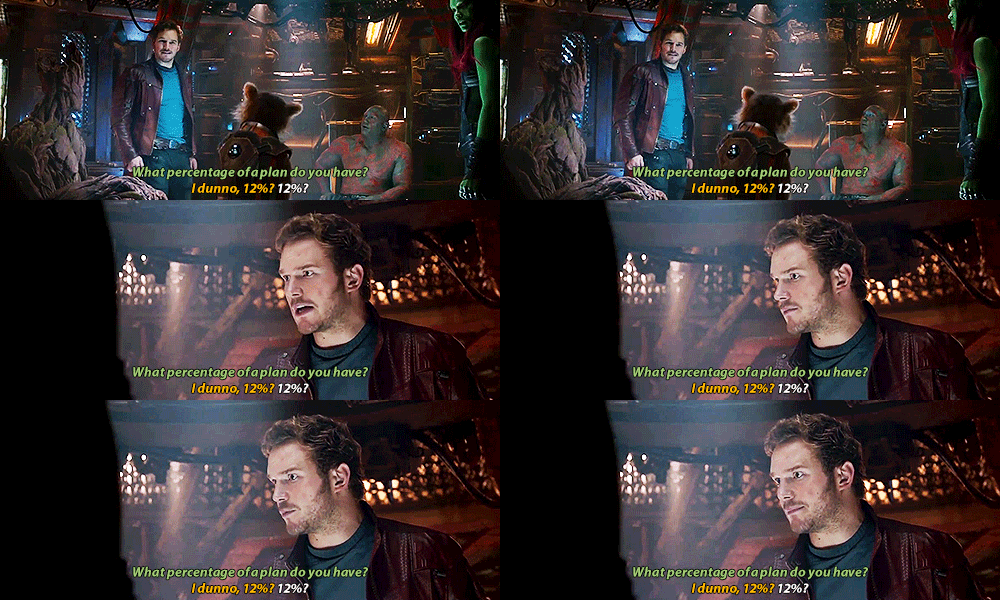
Preferably you'll have more than twelve percent once we're done here.
Why is this important for all you research-lovers out there? Well, because if you have a plan of what you're going to research, you're less likely to get carried away. 
Appropriate gif is appropriate.
So what I do is I make a list of stuff that I need to research. After that, I divide that list into two portions. One that is made up of stuff that I don't need to know for the first draft. So in this list, I might have something like the symptoms of flu, or whatever. While it's helpful and allows you to write more accurately, it isn't necessary for the first draft. That's what editing is for.  
You during editing. Probably.
My second list consists of things that I feel that I need to know before my first draft. For example, as I often write historical stuff, I might need to research the time-period my story is set in. You could argue even that isn't essential, but I prefer to have a good idea of my setting before starting out. Really, this tends to be pretty subjective and differs with what story you're writing. 
It also depends on what sort of writer you are. You might not really care about having a good idea of your setting, preferring to work it out as you go. That's perfectly fine. Honestly, when you come down to it, researching isn't absolutely important for your first draft. It really depends on how much work you want to put in editing it. 
Either way, definitely you during editing. Definitely. Shh, that isn't wishful thinking, what are you talking about?
2) Turn Off Your Internet
Or go somewhere that you don't have internet. I've found that I write best in cafes, personally, so maybe try it out yourself. You can also get any number of internet blockers or distraction-free word processors. I haven't used any of them personally though, so I can't recommend any. Scrivener has a full-screen mode that I've found very useful. 
This means that the ability to research is taken away from you. You can't research anything, so instead you just get on with writing rather than worrying about it. 
This will be you!

3) Have A Notebook To Hand
Why have a notebook? So that you can write down more stuff to research later. I know I said that you should write out a list of what you need to research beforehand, but come on. You're going to discover new things to research and you are going to want to research them. By writing down them down, you're promising yourself that you will research them later. You won't forget about it. And so you can carry on writing without worrying about forgetting to research the year Charles Dickens died. 
Shush, this is necessary. 
4. Bribe Yourself
That sounded weird. What I mean is basically bribe yourself to write a certain amount. This will also work for writer's block. Tell yourself that if you manage to write 2000 words on a particular day, then you can research one of the items on your list. Or you can make yourself a cup of tea, but I feel like the researching thing is more appropriate right now. 
Also, cookies. You can bribe yourself with cookies. 
This is by no means an exhaustive supply of tips. I'm sure you can find more if you look around the internet. But I hope that this has been helpful. I bid you goodbye and leave you with this beautiful thing. 
Very true, good sir. 


Monday, 16 May 2016

Beautiful People: April Edition


This one is kind of late, because the link-up in question was late. But ah well. It doesn't matter, right?
Okay, so this time around I'm going to write about my character Lily Smith from The Gatekeeper Chronicles. She's one of my main character Hubert's best friends. (If you want to know more about Hubert, then I did one of these questionnaires for him in March). She is also my precious sad child who deserves love and affection and hugs. Although she would probably stab someone if they tried to hug her.
Here we go!


How often do they smile? Would they smile at a stranger? 
Rarely and no. Never. She rarely smiles at her friends, why would she smile at a stranger?

What is the cruelest thing they’ve ever been told? And what was their reaction?
Do you want the list? Seriously, this one is hard. Lily had a really depressing childhood, so there's an awful lot of these. So, I don't really know. Maybe when she was bullied for her weak wings?

What is the kindest thing they’ve ever been told? And what was their reaction?
When Hubert says that he likes her and wants to be her friend. It was pretty much the first time anyone had said that and it was kind of the best moment of her life.

What is one strong memory that has stuck with your character from childhood? Why is it so powerful and lasting?
The day that she witnessed her parents' murder. And I should think that would be obvious.

What book (a real actual published book!) do you think your character would benefit from reading?
I don't know, hmmm.... Maybe the Hunger Games Trilogy?

Have they ever been seriously injured? How severely? How did they react?
Yes. She sliced her own wings off with a kitchen knife when she was ten. It was messy. And painful. And it kind of made her depression even worse. (I feel so sorry for this precious child)

Do they like and get along with their neighbours?
No. Lily doesn't like or get along with many people. At all.

On a scale from 1 to 10 (1 being easy and 10 being difficult) how easy are they to get along with?
10. Okay, I'll be a bit nicer. 9. She is not easy to get along with. Drawing her into conversation is like trying to squeeze water from a stone.

If they could travel anywhere in the world, where would they go?
Ooh. Interesting. Probably Russia. She loves Russian architecture and literature.

Who was the last person they held hands with?
Her mother, before she died. I can't think of anyone else at all that she would have held hands with. She's kind of touch-deprived.

Saturday, 26 March 2016

Beautiful People: March Edition


So this week, I've decided to do another of these things. I should probably do these more often, but I keep forgetting they exist. 
So this is a link-up hosted by Paper Fury and Further Up and Further In in which you answer the questions then put your blog-link into the post in question. Something which, incidentally, I forgot to do last time. 
So this month, I've chosen to answer these questions for one of my characters from The Gatekeeper Chronicles. Specifically the main character, Hubert Herrman. 


What first inspired this character? Is there a person/actor you based them off? 
I don't really remember who he was originally inspired by, it was a few years ago that I first had the idea. But I can tell you that his name was originally Ivo and he was a World War Two veteran with a missing leg. Now he's Hubert and he's never been in a war and will probably start crying as soon as I throw him into one. And he has both legs. Yeah, things have changed an awful lot.
I think I took a lot of inspiration originally from the trailer for Percy Jackson and the Sea of Monsters. But I don't remember that well and literally nothing from that has stayed in the story it is now, so I don't really know. 

Describe their daily routine.
It really depends on which point in the story. If you're talking pre-story, then he'd wake up around seven-ish, head to work at the newpaper for about half-eight then come home for tea at six. That's a fairly regular thing. And he'd spend far more of his free time than is actually healthy at the library. 
During the story, basically trying not to die. And that is really a harder task than it sounds.


If they joined your local high school, what clique would they fit into?
Okay, so I'm not in school, so I'm probably not the best person to ask. I'll probably just go with film-stereotypes here. Hubert would be the weird nerd who always hangs out in the library and hides from everyone. But who is actually super-nice and is probably also pretty popular. He'd have an unreasonable amount of friends for someone who never talks to anyone. 

Write a list of things they merely tolerate. Ex: certain people, foods, circumstances in their lives...
His little sister, being the centre of attention (or any attention at all), mashed potato.

How do they react in awkward silences?
He'd get out of the situation as soon as possible. Whether he'd pull out the book he's inevitably been carrying, sneak away or loudly announce that he wants to become a librarian, he'd find someway to escape. 

Can they swim? If so, how did they learn? 
I'm pretty sure that he can, but it's not something he does an awful lot, so he's not very good at it.

What is one major event that helped shape who they are?
The murder of his other little sister was a big thing that changed him. It's impacted a lot of his actions throughout his life and the story. 

What things do they value most in life?
Majorly, his family. Hubert loves his family and would do anything for them. The same is true for the few friends that he starts out with and the friends he later finds. 
Also, he really values historical artefacts and monuments. He gets really annoyed when people hurt them. And books. Books are important in life. 

Do they believe in giving other people second chances? Do they have any trust issues?
Yes, Hubert believes very firmly in second chances. He's always the first to forgive. He does have some major trust issues, but he doesn't let them get in the way of forgiving people. 

Your character is having a rough day...what things do they do to make them happy again? Is there anyone they talk/interact with to get in a better mood?
He'd read. Definitely. But spending time with his alive-sister would rate pretty high on the list. And spending time with his best friends. And also his girlfriend. He just likes people. But not necessarily a lot of people.

Thursday, 17 March 2016

Writer's Block

Recently, I've been attempting (keyword: attempting) to continue with the second draft of the first book of The Gatekeeper Chronicles.
And it hasn't been going too well. I was hoping to get a second draft done by June, but that's not happening. I started out the year with about 17000 words and I've now got nearly 19000. 
Sherlock gifs are very appropriate for this post. And this one in particular.
I could come up with any number of reasons for this, I've had assignments to write for my Open University degree, I often didn't feel well and so on. 
But the truth is I've just been having some real trouble. Every time I sat down to write it, I'd end up cringing at every single word I'd written then deleting them. Nothing felt right. I regretted writing historical fantasy, writing a character with a concussion and literally everything. 
Me. Also, more Sherlock gifs. Yay!

So, I started avoiding it. I procrastinated on Pinterest. I started watching Man from UNCLE and Hornblower, as my last post stated. I started about three new stories. I read books. I read writing blogs. 
I did not, however, play the violin. Though I could. I also procrastinate that as well. 
I began to be almost afraid of opening up the document. And I hated it. 
Because I love this story. It's probably my favourite of all the ones I've written. I don't love any of my characters the way I do this bunch. I love writing it. I love the world. I love everything about it. And suddenly, I couldn't write it. 
I too become a murderous sociopath when I can't write.
And it was really starting to get to me. 
But then today, I opened up Scrivener and opened the document on an impulse. I started typing a few words, again groaning as I wrote them. Then I got an idea. 
You see, at the point that I was stuck, I was in the middle of an action scene that just wasn't happening. And there's this character that I was going to introduce later in the series. And I thought, well, try throwing him in. It might just solve the problem. 
And it did. 
This was basically me.
I realised that I'd been going about it all wrong. I was trying to force a fight scene that wasn't working, whilst also insisting to myself that this character shouldn't appear yet even though I had no idea when I was going to introduce him. 
But I put him in and suddenly everything made sense. I won't go into details, but I'm excited about this story for the first time in months. And it's the best. 
Me right now.
But what's the point of this post? What am I getting at here, you ask? 
Well, here's the thing. All us writers know what writing block is like. And we all know what it's like to not have that scene going right. We know what it's like to be lying awake at night desperately trying to puzzle out how to write it correctly. 
We are all Sherlock.

But tell me this, have you looked at it differently? Is there something that you're saving, either for the end of the novel or later in your book series that you could toss in there? Are your character motivations on point?
Mine weren't. I thought my characters were being chased by bad guys, but it turns out that nope! They were good guys. 
My characters are the 'he' in question.
It was very confusing. And surprising. But also awesome. (On the downside, I now have yet another side in the story's conflict to write about).
So, in summary, don't give up. Try thinking differently, throwing things in that you didn't plan (I'm looking at you, planners). Nothing's set in stone, just because it wasn't what you originally wanted doesn't mean that it won't make your story better as a whole. 
Anyway, that's all I wanted to say to you today. So, I say goodbye now!
And leave you with another Sherlock gif.
What do you mean, this has nothing to do with anything?

Saturday, 30 January 2016

Book Review: Illuminae by Amie Kaufman and Jay Kristoff

Hey guys!
So I haven't written on here for months and I...don't really have an excuse. Although I have recently been swallowed by the fandom pits that are Hornblower and The Man From U.N.C.L.E. respectively, so I suppose that kind of is. *shrugs*
Anyway, I read this book around Christmas and I adored it so I thought why not do a review on it? So, here you are. Also, I'm going to use Hornblower and Man from Uncle GIFS because I can, so deal with it.

Does this fit? Who knows, but it's an epic moment so I don't even care.
Okay, so onto the actual purpose of this post. A review of Illuminae. Right. First of all, this is the book in question.


First, what's it about, you might ask?
Well, it's about spaceships and corrupt authority and zombies and a really adorable romance that I got really attached to. Also there's an evil computer who's only sort of evil and you'll get attached to him too. And there's other stuff too, like an actual plot. I don't know, I'm not good at describing books. I'm also doing my best to avoid spoilers, so bleh.
What? Did you expect a proper serious review that doesn't involve me fangirling and overusing GIFs? Ha!
But because I am technically reviewing it, let's look at the different stuff that's important in a story and how well (or badly) Illuminae did it.

Plot
Going back to the plot, in all seriousness this plot was amazing. It had so many unexpected twists and turns. I couldn't predict any of it, once I passed a certain point particularly. I was practically on the edge of my seat until the last few pages. And even then to some extent.

Basically how I felt during some of these twists.
And some of them really hurt, but in a good way. Sort of.

World-Building
Oh, boy. The world-building here was incredible. I'll talk more about the way it was written when I talk about style, but there was some stuff in this book that just made it so much more real. But it wasn't just that. The whole way the politics of the thing were arranged and the descriptions of the virus in particular just made the world burst with colour. It was so amazing. Such a thrill.

I am Mr. Bush here and Hornblower is the book. Just so you know.
Style
And now we're on to style. And let me tell you, the way this book was written was so good. And very unusual. You see, there weren't many bits that were written like a standard book. Instead there was a lot of images...


...As you can see in the above photographs. You might think that this would make it harder to read, or that the characters and story might not come across as well, but it doesn't affect it like that at all. In fact, sometimes it made it better than it would've been just as a written book. And it was really emotional at times. I was nearly full-out sobbing at parts in this book (though admittedly it was worse with The Book Thief).

Literally me. 
As someone who's read some of Jay Kristoff's writing (specifically some of Stormdancer), I knew I'd love at least some of it as I really enjoy his style and I wasn't disappointed. In fact, I'm more excited to finish Stormdancer than I was before and now I also want to read some of Amie Kaufman's writing. 

Characters
The characters in this were amazing. So beautiful. 
There were two main characters, Kady and Ezra, and both of them were awesome though in their own ways. I found it really impressive how well their different voices came through and made them sound like genuinely different people. Also, their romance is literally the best thing ever. And will make you cry. 
All the characters will probably make you cry at some point, though. Particularly one with a name beginning with J. You'll know when it comes. 
Also so much death and it makes me cry all the tears. Seriously, I would be hard-pressed to name a non-dead character in this book. 

Well. they can't die. but anyway, appropriate GIF is appropriate.
Which one was my favourite, I hear you ask? 

Did I just want to use a Man from Uncle TV show GIF? Maybe. 
I really can't choose. There's so many amazing characters in this book. And they all hurt my heart so much. Even the computer. (Maybe especially the computer).

So, in summary, this is a really good book. Probably my favourite book that I read in 2015. It's well-written, has some amazing and deeply complex characters and some breathtaking world-building. I read it in about three hours. And it is not a thin book, in fact it's nearly six hundred pages long. Admittedly, I'm a fast reader, but that's pretty quick even for me.
You should all read it. Share the pain. 

COME!
Also, am I over-using GIFs in this blogpost? Maybe, but I love GIFs so I really don't care.
So my question for you is have you read Illuminae? If so, what did you think of it?

Wednesday, 23 September 2015

Beautiful People: Helen Cambria


Okay, so this is a linkup hosted by Paperfury and Further Up and Further In where you answer questions about your characters. I recently found this over on Victoria Grace Howell's blog, you can find the link to that post here: http://storitorigrace.blogspot.co.uk/2015/09/beautiful-people-13-caleb.html
I thought it looked fun, so here we go.

I chose the main character from my new currently untitled WIP, Helen Cambria

1. They’re in a crisis: who would they really like to see right now?
Her brother, Hector or her best friend, Edmund.

2. Are they easy to get along with?
Helen can be difficult, simply because she tends to push people away a lot. But once you do make friends with her, you’ll likely get on very well and she will be eternally loyal to you.

3. Who was the last person they had a deep conversation with?
Edmund.

4. They’re in the middle of a huge crowd of people: how do they feel?
Helen would feel comfortable, as she would feel more hidden and able to carry out her objective.

5. Do they believe in luck or miracles?
She doesn’t believe in either.

6. Do they like and get along with their neighbors?
She lives in one of the roughest parts of Layabout (Liverpool), but she is on friendly terms with a lot of her neighbours (where she lives this mostly amounts to not turning them into the police). 

7. If they could travel anywhere in the world, where would they go?
She’d go to Greece, because she loves Greek mythology and history.

8. How do they feel about their body?
She doesn’t really care either way. She’s aware that she’s underweight, due to malnourishment, so she rarely worries about fat. She doesn’t think she’s particularly pretty, but doesn’t really care about it.

9. What is the cruellest thing someone has ever said to them? How did they react?
The cruellest thing anyone ever said to her….well, she’s been insulted a lot, due to her abusive upbringing and where she grew up but it probably hurt the most when Deirdre, someone she believed was her friend, said that she couldn’t possibly be friends with a poverty-stricken illiterate. She reacted by punching her, then crying in a hole somewhere that no one could find her in.

10. What’s the kindest thing someone has ever said to them? How did they react?
When Carlisle told her that she was beautiful and that he would teach her to read.


Know The Novel - Introducing The Prospero Hotel

Hello! FallFicFrenzy is back and so is Know The Novel, and you know what that means. My one post a year is back, folks.  This year, I'm...